
Four verbs decide your interview. Most résumés pick the wrong one.
You wrote “owned the maintenance program” because it sounded like the job you want. Somewhere in the interview, a hiring manager is going to ask who had to live with your decisions, and the verb you picked already told them where to aim.
Most résumé advice stops at “use strong action verbs.” It skips the part that matters: a verb is a claim about authority, and the claim gets tested by someone who does this all day.
The gap employers see, and the gap you would admit to
In a Harris Poll conducted for Express Employment Professionals and published in February 2026, 80% of 1,002 U.S. hiring decision-makers said candidate résumés do not match real-world skills at least some of the time. Thirty-four percent said it happens often or constantly. Asked from the other side, only 22% of job seekers admitted to listing skills they do not actually have.
Eighty percent against twenty-two. Sit with that gap, because the easy reading of it is wrong.
That gap is not mostly a lying problem. It is a precision problem.
Most of the distance between those two numbers is made of people who described work they really did, using a word that claimed a little more authority than they held. They were not inventing anything. They were reaching for the word that sounded like the job.
The same poll found 86% of hiring managers believe AI makes it too easy to embellish a résumé. They are not wrong about the outcome. They are often wrong about the cause.
A verb is a claim about authority
Four words that get used interchangeably are not interchangeable at all.
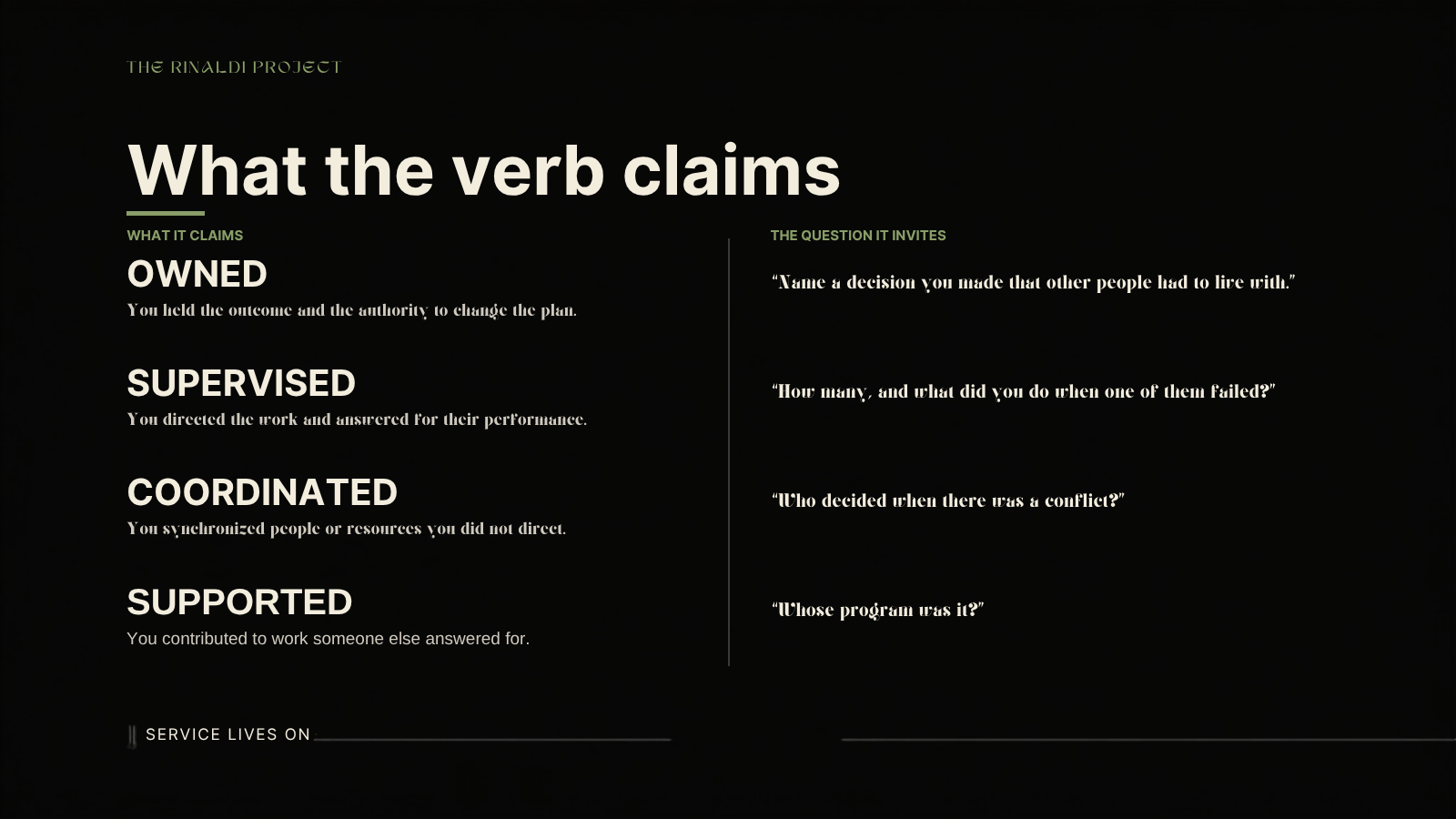
Supported says you contributed to work someone else answered for. Coordinated says you synchronized people or resources you did not direct. Supervised says you directed people’s work and answered for their performance. Owned says you held the outcome and the authority to change the plan.
Each one hands the interviewer a different question. “Supported” invites whose program was it? “Coordinated” invites who decided when there was a conflict? “Supervised” invites how many, and what did you do when one of them failed? “Owned” invites the hardest one: name a decision you made that other people had to live with.
Pick a verb one rung above where you actually stood and you will get the question for that rung. You will answer it honestly, the answer will not match the word, and the interviewer will quietly move you down their list without telling you why.
The résumé promoted you. The interview will demote you.
Under-claiming costs you the same interview
The reverse error is just as common among veterans and military families, and it costs just as much.
Plenty of people who held real accountability write “assisted with” or “was part of a team that.” A platoon sergeant responsible for the readiness of people and equipment writes a line that reads like an intern’s. The civilian reader has no way to recover what was left out, because the whole point of the résumé is that they were not there.
Precision runs in both directions. The goal is not a smaller verb. It is the true one.
The model reaches for the biggest verb in the room
This is the mechanism behind that 86%.
Ask a model to make a line sound more senior and it will do exactly that. It has no access to your evaluation record, your chain of command, or the moment you needed permission you did not have. It optimizes for register, and the most senior-sounding register is the one with the biggest verbs in it.
So the line comes back with “owned,” “spearheaded,” “directed.” Nothing in the tool tells you that you just made a claim about authority. You asked for tone. It gave you a promotion.
Friday’s Dispatch translated reporting from Military.com in which RecruitMilitary’s CEO named translation as the real gap between veterans and the roles that want them. This is the smallest unit of that gap: one word.
Teardown: one job, four verbs
Constructed example. Not a real person or a TRP client. The role and numbers exist only for this illustration.
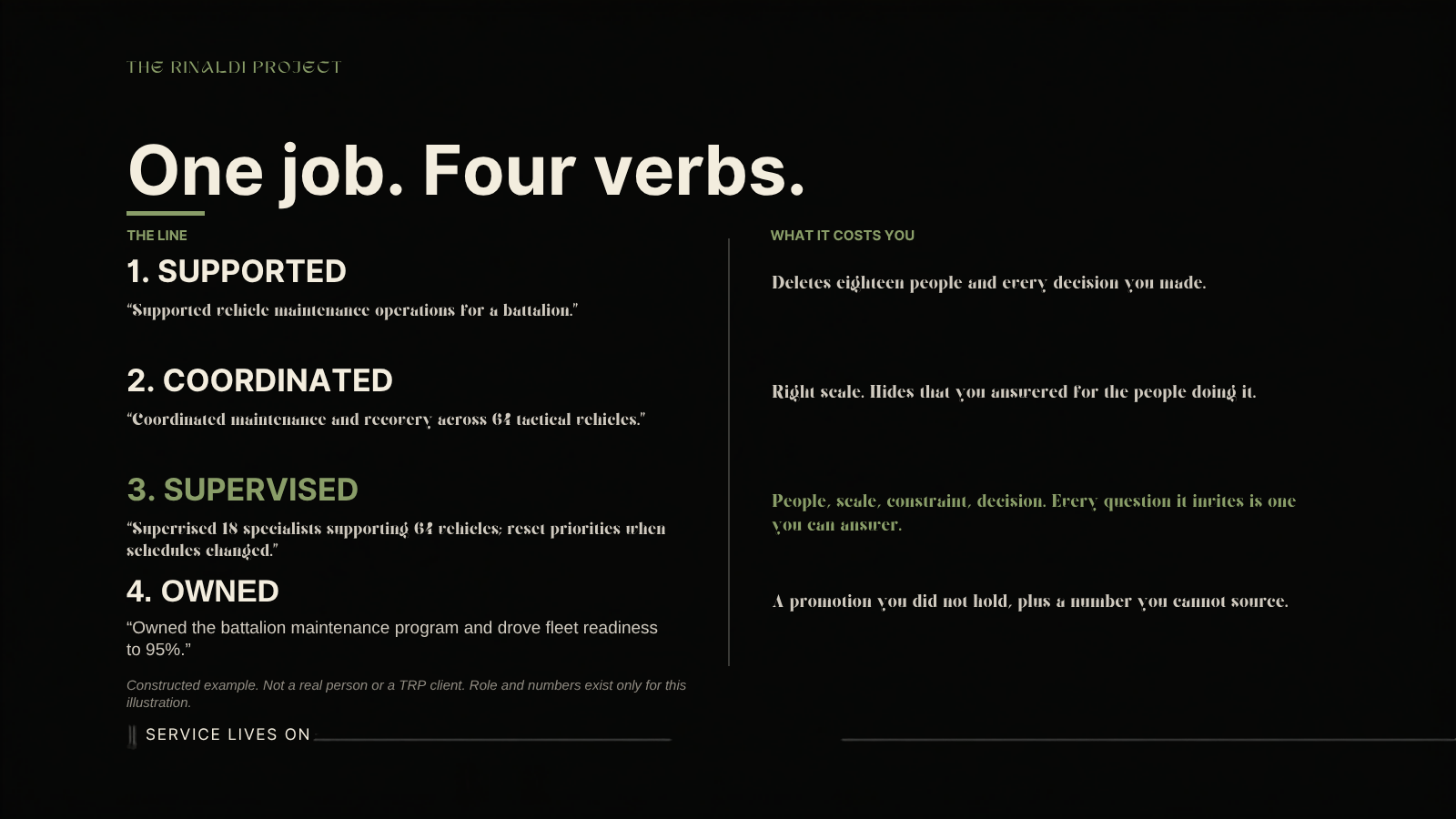
1. Supported. “Supported vehicle maintenance operations for a battalion.” True, and it deletes eighteen people and every decision you made.
2. Coordinated. “Coordinated maintenance and recovery across 64 tactical vehicles.” Closer on scale. Still hides that you answered for the performance of the people doing it.
3. Supervised. “Supervised 18 vehicle maintenance specialists supporting 64 tactical vehicles; reset repair and recovery priorities when training schedules changed.” Accurate. Names the people, the scale, the constraint, and the decision. Every question it invites is one you can answer.
4. Owned. “Owned the battalion maintenance program and drove fleet readiness to 95%.” This is the one a model writes when you ask it to sound senior. It promotes you into ownership of a program, and it attaches a number you cannot source.
Version three is not the modest option. It is the strongest one, because it is the only one that survives being asked about.
Tactic: run the verb audit this week
Open your résumé and circle every verb. Write the number down. Most one-page résumés carry between twelve and twenty.
Beside each one, write the interview question it invites, in a single sentence.
Any verb whose question you cannot answer with a specific, nameable instance gets downgraded one rung. Any verb where you can answer a harder question than the one you invited gets upgraded one rung.
Check each verb against the record, not against memory. Evaluations, award citations, and position descriptions are the source. If the record and the verb disagree, the record wins.
Read each line aloud, then answer out loud: “Tell me exactly what you mean by that.” Any sentence you cannot finish comfortably gets rewritten before it gets sent.
If a number is missing, leave the question open rather than closing it with a figure you cannot explain. An unanswered question is a conversation. A wrong number is a disqualification.
Field note
September is National Preparedness Month, and the principle applies to a career the same way it applies to anything else: build the record before you need it.
Keep a plain account of what you were responsible for, how many people and how much equipment, what constrained you, and what you decided, while you can still recall the detail. Do that and the verb question answers itself, because you will not be reaching for a word. You will be reporting one.
Your experience does not need to be inflated. It needs to be legible.
The Rinaldi Project supports veterans and military families in the first year after separation or retirement through practical employment transition support. Four services, free: military-to-civilian résumé translation, LinkedIn rebuild, interview preparation, and portfolio-ready work sample creation.
Or forward this to someone who is in it.
Keep the experience. Make it legible.
Survey data: The Harris Poll, conducted on behalf of Express Employment Professionals, published February 11, 2026. Job Insights survey of 1,002 U.S. hiring decision-makers, fielded November 3 to 19, 2025; Job Seeker Report of 1,003 U.S. adults, fielded November 7 to 20, 2025. The Rinaldi Project did not conduct this research and has no relationship with Express Employment Professionals or The Harris Poll.
Rinaldi Project Corporation is a 501(c)(3) public charity. EIN 33-1429054.